> ## Documentation Index
> Fetch the complete documentation index at: https://dripart-docs-recommend-assets-api.mintlify.site/llms.txt
> Use this file to discover all available pages before exploring further.
# 如何在不同系统上手动安装 ComfyUI
> 本部分将指导你完成在 Windows、MacOS 以及 Linux 的手动安装过程
对于 ComfyUI 的安装, 主要分为几个步骤
1. 创建一个虚拟环境(避免污染系统级 Python 环境)
2. 克隆 ComfyUI 代码仓库
3. 安装依赖
4. 启动 ComfyUI
你也可以参考 [ComfyUI CLI](/zh/comfy-cli/getting-started) 来安装 ComfyUI, 它是一个命令行工具,可以方便地安装 ComfyUI 并管理其依赖。
## (可选)创建虚拟环境
独立的虚拟环境是必要的,因为 ComfyUI 的依赖可能会与系统上的其他依赖冲突,也可以避免对系统级 Python 环境的污染。
[Install Miniconda](https://docs.anaconda.com/free/miniconda/index.html#latest-miniconda-installer-links). 这将帮助您安装 ComfyUI 所需的正确版本的 Python 和其他库。
使用 Conda 创建一个环境。
```
conda create -n comfyenv
conda activate comfyenv
```
## 克隆代码仓库
你需要保证你的系统上已经安装了 [Git](https://git-scm.com/downloads), 首先你需要打开终端(命令行),然后克隆代码仓库。
如果你还没有安装 Microsoft Visual C++ Redistributable,请在[这里安装](https://learn.microsoft.com/en-us/cpp/windows/latest-supported-vc-redist?view=msvc-170)
打开终端应用程序。
打开[终端应用程序](https://support.apple.com/guide/terminal/open-or-quit-terminal-apd5265185d-f365-44cb-8b09-71a064a42125/mac)。
```bash theme={null}
git clone git@github.com:comfyanonymous/ComfyUI.git
```
## 安装GPU 及 ComfyUI 依赖
安装 GPU 依赖
```
conda install pytorch torchvision torchaudio pytorch-cuda=12.1 -c pytorch -c nvidia
```
或者,您可以安装 PyTorch 的夜间版本。
安装夜间版本(可能风险更大)
```
conda install pytorch torchvision torchaudio pytorch-cuda=12.1 -c pytorch-nightly -c nvidia
```
```
pip3 install torch torchvision torchaudio --index-url https://download.pytorch.org/whl/rocm6.0
```
或者,您可以安装 PyTorch 的夜间版本。
安装夜间版本(可能风险更大)
```
pip3 install --pre torch torchvision torchaudio --index-url https://download.pytorch.org/whl/nightly/rocm6.0
```
```bash theme={null}
conda install pytorch-nightly::pytorch torchvision torchaudio -c pytorch-nightly
```
```bash theme={null}
cd ComfyUI
pip install -r requirements.txt
```
启动 ComfyUI
```
cd ComfyUI
python main.py
```
## 如何更新 ComfyUI
使用命令行进入 ComfyUI 的安装路径,然后拉取最新代码。
```bash theme={null}
cd <安装路径>/ComfyUI
git pull
```
使用命令行进入 ComfyUI 的安装路径,然后安装依赖。
你需要确保当前的 Python 环境是 ComfyUI 的虚拟环境,否则依赖会安装到系统级 Python 环境,污染系统级 Python 环境。
```bash theme={null}
pip install -r requirements.txt
```
## 添加外部模型路径
如果你想要在 `ComfyUI/models` 之外管理你的模型文件,可能出于以下原因:
* 你有多个 ComfyUI 实例,你想要让这些实例共享模型文件,从而减少磁盘占用
* 你有多个不同的类型的 GUI 程序,如:WebUI, 你想要他们共用模型文件
* 模型文件无法被识别或读取到
我们提供了通过 `extra_model_paths.yaml` 配置文件来添加额外模型搜索路径的方法。
### 不同 ComfyUI 版本配置文件位置
对于[便携版](/zh/installation/comfyui_portable_windows)和[手动安装](/zh/installation/manual_install)的 ComfyUI版本,你可以在 ComfyUI 的根目录下找到 `extra_model_paths.yaml.example` 的示例文件
```
ComfyUI/extra_model_paths.yaml.example
```
复制并重命名为 `extra_model_paths.yaml` 来使用, 并保持在 ComfyUI 的根目录下, 路径应该是 `ComfyUI/extra_model_paths.yaml`
你也可以在 [这里](https://github.com/comfyanonymous/ComfyUI/blob/master/extra_model_paths.yaml.example) 找到配置示例文件
如果你使用的是 ComfyUI 桌面应用程序,你可以参考下图打开额外模型的配置文件:
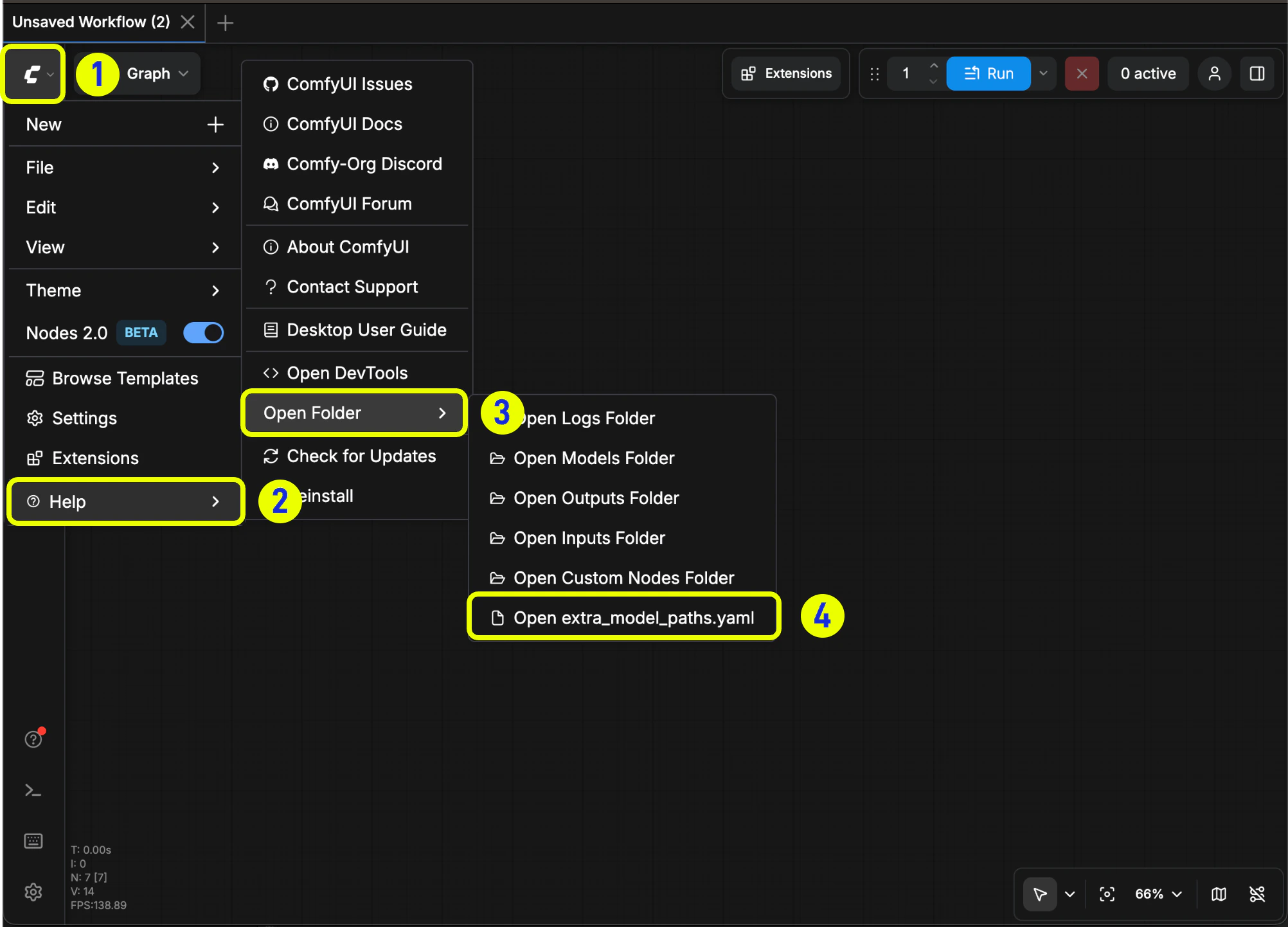 或者通过下面的位置打开:
```
C:\Users\YourUsername\AppData\Roaming\ComfyUI\extra_models_config.yaml
```
```
~/Library/Application Support/ComfyUI/extra_models_config.yaml
```
对应的配置文件不应该被改变
### 配置示例
比如,你需要额外让 ComfyUI 识别的模型文件位于下面的文件夹:
```
📁 YOUR_PATH/
├── 📁models/
| ├── 📁 loras/
| │ └── xxxxx.safetensors
| ├── 📁 checkpoints/
| │ └── xxxxx.safetensors
| ├── 📁 vae/
| │ └── xxxxx.safetensors
| └── 📁 controlnet/
| └── xxxxx.safetensors
```
那么你可以进行如下的配置来让 ComfyUI 识别到你设备上的模型路径
```
my_custom_config:
base_path: YOUR_PATH
loras: models/loras/
checkpoints: models/checkpoints/
vae: models/vae/
controlnet: models/controlnet/
```
或者使用
```
my_custom_config:
base_path: YOUR_PATH/models/
loras: loras
checkpoints: checkpoints
vae: vae
controlnet: controlnet
```
对于桌面版,请在原有配置路径下新增配置,而不覆盖掉安装过程中自动生成的路径配置,请在修改前备份对应的文件,这样在你配置错误时可以及时恢复
或者你也可以参考默认的 [extra\_model\_paths.yaml.example](https://github.com/comfyanonymous/ComfyUI/blob/master/extra_model_paths.yaml.example) 来配置,保存之后, 需要 **重启 ComfyUI** 才能生效。
下面是完整的原始的配置配置示例:
```yaml theme={null}
#Rename this to extra_model_paths.yaml and ComfyUI will load it
#config for a1111 ui
#all you have to do is change the base_path to where yours is installed
a111:
base_path: path/to/stable-diffusion-webui/
checkpoints: models/Stable-diffusion
configs: models/Stable-diffusion
vae: models/VAE
loras: |
models/Lora
models/LyCORIS
upscale_models: |
models/ESRGAN
models/RealESRGAN
models/SwinIR
embeddings: embeddings
hypernetworks: models/hypernetworks
controlnet: models/ControlNet
#config for comfyui
#your base path should be either an existing comfy install or a central folder where you store all of your models, loras, etc.
#comfyui:
# base_path: path/to/comfyui/
# # You can use is_default to mark that these folders should be listed first, and used as the default dirs for eg downloads
# #is_default: true
# checkpoints: models/checkpoints/
# clip: models/clip/
# clip_vision: models/clip_vision/
# configs: models/configs/
# controlnet: models/controlnet/
# diffusion_models: |
# models/diffusion_models
# models/unet
# embeddings: models/embeddings/
# loras: models/loras/
# upscale_models: models/upscale_models/
# vae: models/vae/
#other_ui:
# base_path: path/to/ui
# checkpoints: models/checkpoints
# gligen: models/gligen
# custom_nodes: path/custom_nodes
```
### 添加额外自定义节点路径
除了添加外部模型之外,你同样可以添加不在 ComfyUI 默认路径下的自定义节点路径
请注意,这并不会改变自定义节点的默认安装路径,只是在启动 ComfyUI 时会增加额外的路径搜索,你仍旧需要在对应的环境中完成自定义节点的依赖的安装,来保证其运行环境的完整性。
下面是一个简单的配置示例(Mac 系统),请根据你的实际情况进行修改,并新增到对应的配置文件中,保存后需要 **重启 ComfyUI** 才能生效:
```yaml theme={null}
my_custom_nodes:
custom_nodes: /Users/your_username/Documents/extra_custom_nodes
```
或者通过下面的位置打开:
```
C:\Users\YourUsername\AppData\Roaming\ComfyUI\extra_models_config.yaml
```
```
~/Library/Application Support/ComfyUI/extra_models_config.yaml
```
对应的配置文件不应该被改变
### 配置示例
比如,你需要额外让 ComfyUI 识别的模型文件位于下面的文件夹:
```
📁 YOUR_PATH/
├── 📁models/
| ├── 📁 loras/
| │ └── xxxxx.safetensors
| ├── 📁 checkpoints/
| │ └── xxxxx.safetensors
| ├── 📁 vae/
| │ └── xxxxx.safetensors
| └── 📁 controlnet/
| └── xxxxx.safetensors
```
那么你可以进行如下的配置来让 ComfyUI 识别到你设备上的模型路径
```
my_custom_config:
base_path: YOUR_PATH
loras: models/loras/
checkpoints: models/checkpoints/
vae: models/vae/
controlnet: models/controlnet/
```
或者使用
```
my_custom_config:
base_path: YOUR_PATH/models/
loras: loras
checkpoints: checkpoints
vae: vae
controlnet: controlnet
```
对于桌面版,请在原有配置路径下新增配置,而不覆盖掉安装过程中自动生成的路径配置,请在修改前备份对应的文件,这样在你配置错误时可以及时恢复
或者你也可以参考默认的 [extra\_model\_paths.yaml.example](https://github.com/comfyanonymous/ComfyUI/blob/master/extra_model_paths.yaml.example) 来配置,保存之后, 需要 **重启 ComfyUI** 才能生效。
下面是完整的原始的配置配置示例:
```yaml theme={null}
#Rename this to extra_model_paths.yaml and ComfyUI will load it
#config for a1111 ui
#all you have to do is change the base_path to where yours is installed
a111:
base_path: path/to/stable-diffusion-webui/
checkpoints: models/Stable-diffusion
configs: models/Stable-diffusion
vae: models/VAE
loras: |
models/Lora
models/LyCORIS
upscale_models: |
models/ESRGAN
models/RealESRGAN
models/SwinIR
embeddings: embeddings
hypernetworks: models/hypernetworks
controlnet: models/ControlNet
#config for comfyui
#your base path should be either an existing comfy install or a central folder where you store all of your models, loras, etc.
#comfyui:
# base_path: path/to/comfyui/
# # You can use is_default to mark that these folders should be listed first, and used as the default dirs for eg downloads
# #is_default: true
# checkpoints: models/checkpoints/
# clip: models/clip/
# clip_vision: models/clip_vision/
# configs: models/configs/
# controlnet: models/controlnet/
# diffusion_models: |
# models/diffusion_models
# models/unet
# embeddings: models/embeddings/
# loras: models/loras/
# upscale_models: models/upscale_models/
# vae: models/vae/
#other_ui:
# base_path: path/to/ui
# checkpoints: models/checkpoints
# gligen: models/gligen
# custom_nodes: path/custom_nodes
```
### 添加额外自定义节点路径
除了添加外部模型之外,你同样可以添加不在 ComfyUI 默认路径下的自定义节点路径
请注意,这并不会改变自定义节点的默认安装路径,只是在启动 ComfyUI 时会增加额外的路径搜索,你仍旧需要在对应的环境中完成自定义节点的依赖的安装,来保证其运行环境的完整性。
下面是一个简单的配置示例(Mac 系统),请根据你的实际情况进行修改,并新增到对应的配置文件中,保存后需要 **重启 ComfyUI** 才能生效:
```yaml theme={null}
my_custom_nodes:
custom_nodes: /Users/your_username/Documents/extra_custom_nodes
```